Universidad de los Andes announced the results achieved by its academics and researchers, who obtained support for the development of their projects, which will contribute to society thanks to this recognition.
Universidad de los Andes registered 21 selected projects out of a total of 65 applications, reaching an award rate of 32.3%, a result that places it in a range consistent with the historical performance of the national Fondecyt system.
After learning the results of the Fondecyt Regular 2026 Competition, the University confirmed its institutional performance both in its award rate and its positioning in key reference areas.This result takes place in a context of a sustained increase in the number of applications at the national level, which reflects greater participation by the academic community in an increasingly competitive and demanding landscape.
The projects proposed for funding in the Regular Fondecyt competition were published on January 23, 2026, by the National Research and Development Agency (Agencia Nacional de Investigación y Desarrollo,ANID), consolidating it as one of the main instruments of public funding for research excellence in Chile.
The University actively participated in both this call and the Postdoctoral and Initiationmodalities, as part of its strategy for strengthening institutional research. According to the national list, out of 680 projects proposed for funding, the University registered 21 selected projects out of a total of 65 applications, achieving an award rate of 32.3%.
This result places UANDES in a range consistent with the historical performance of the national Fondecyt system, whose average award rate, considering all modalities, has been around 32.75% during the 2020-2024 period.
It is worth noting that 4 of the 21 projects proposed for funding were led by female principal investigators,representing 19% of the institutional total. Female participation is mainly concentrated in the areas of Biomedicine and Legal Sciences,wich coincide with the areas of greatest consolidation and recognition within the University, a pattern that is consistent with the structural characteristics and academic trajectories of Fondecyt Regular.
| Title | Responsible Researcher | Academic Unit | Sub U.A. | AU Secondary | Study group (Fondecyt) |
| Arbitral partition of assets as an obstacle to access to justice | Alejandro César Romero Seguel | School of Law | Cs. Legal and Political Sciences | ||
| Economic-financial participation of employees in the company | Alfredo Sierra Herrero | School of Law | Cs. Legal and Political Sciences | ||
| Removal of micropollutants and their influence on N2O emissions | César Esteban Huiliñir Curio | School of Engineering and Applied Sciences | Engineering 3 | ||
| Who Follows Mass Financial Advice? | Felipe Eduardo Aldunate Anfossi | ESE Business School | Cs. Economic and Administrative Sciences | ||
| Statute of criminal liability of natural and legal persons | Gonzalo Patricio García Palominos | School of Law | Cs. Legal and Political Sciences | ||
| Structure-based design of amyloid fibrillar assemblies | Ingrid Macarena Contardo Hernández | School of Medicine | School of Nutrition and Dietetics | CIIB | Engineering 3 |
| Click-Chemistry Enabled Hybrid Microgels | Javier Ignacio Enrione Cáceres | School of Medicine | School of Nutrition and Dietetics | CIIB | Engineering 3 |
| Decoding MAVS Dysfunction in the Aging Lung | Jimena Cuenca Moreno | School of Medicine | School of Medicine | CIIB | Medicine G1 - Biomedical Ss. |
| Evaluation of the Acceptability, Feasibility and Exploration of CARIBOU | Jorge Eduardo Gaete Olivares | School of Social Sciences | School of Education | Psychology | |
| Supply-side Incentives and Labor Market Responses | Jorge Patricio Rodríguez Osorio | School of Economics and Business Administration | Cs. Economic and Administrative Sciences | ||
| High-fidelity performance-based seismic design | José Antonio Abell Mena | School of Engineering and Applied Sciences | Engineering 1 | ||
| Leveraging Visual Latent Space and Large Language Models | José Manuel Saavedra Rondo | School of Engineering and Applied Sciences | Engineering 2 | ||
| Metaphysics of universals, divine aseity and fundamental negativity. | José Tomás Alvarado Marambio | School of Philosophy and Humanities | Institute of Philosophy | Philosophy | |
| IL-33 as a modulator of Tryptophan metabolism | Karina de las Mercedes Pino Lagos | School of Medicine | School of Medicine | CIIB | Medicine G1 - Biomedical Ss. |
| Ascetic itinerary and biblical examples | Marcelo Eugenio Aguirre Durán | School of Philosophy and Humanities | Institute of History | History | |
| Enhancing Hematopoietic Stem Cell Transplantation | Maroun Khoury | School of Medicine | School of Medicine | CIIB | Medicine G1 - Biomedical Ss. |
| Tackling Inequality in the Transition | Mauricio Andrés Barrios Fernández | School of Economics and Business Administration | Cs. Economic and Administrative Sciences | ||
| Contribution to the professional society | Pablo Manterola Domínguez | School of Law | Cs. Legal and Political Sciences | ||
| Incorporating microclimate as a new variable | Patricio Andrés Pliscoff Varas | Center for Territorial Studies | Geography and Urban Planning | ||
| Dogmatic reconstruction of the power to impose sanctions | Rosa Inés Fernanda Gómez González | School of Law | Cs. Legal and Political Sciences | ||
| Evaluating CCR5 Blockade as an Adjuvant to Anti-PD-1 Immunotherapy | Wilfredo Alejandro González Arriagada | School of Dentistry | CIIB | Medicine G1 - Biomedical Ss. |
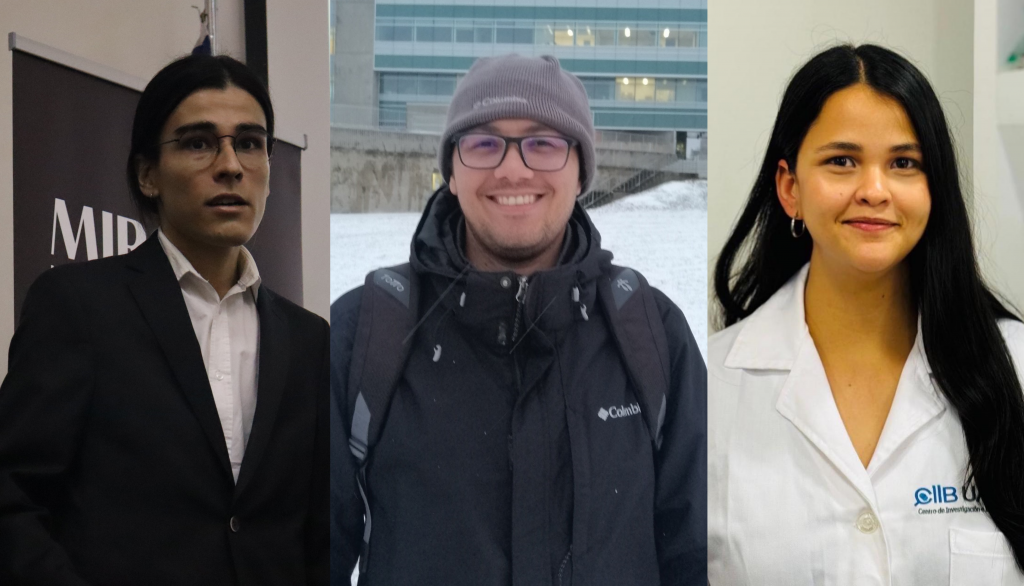
Fondecyt of Initiation 2026
Within the framework of this competition, the projects proposed for funding address issues related to maternal and child health, neurodevelopment, applied social sciences, and emerging technologies.This program allows researchers in the early stages of their careers to advance their own lines of research.
The academics awarded Fondecyt of Initiation 2026 funding are:
- Mario Sánchez Rubio (Center for Biomedical Research and Innovation CiiB)): a project using artificial intelligence to analyze molecular biomarkers present in the umbilical cord,aimed at studying the relationship between maternal stress during pregnancy and infant brain development and temperament.
- Reyna Peñailillo Escárate (School of Nursing and Midwifery): research analyzing how postpartum depression can alter breast milk composition and its impact on infant neurodevelopment.
- Hugo Benedetti Espinoza (ESE Business School): a study analyzing the blockchain ecosystem through digital transaction and network behavior data,aimed at understanding the dynamics of crypto-asset markets.
- Marcela Mello Silva (School of Economics and Business Administration): a project analyzing the social, political, and economic transformations associated with the growth of Pentecostal communities in the region.
- Felipe Guzman (School of Economics and Business Administration)Research on the processes associated with the emergence of leadership in multinational and multicultural work teams.
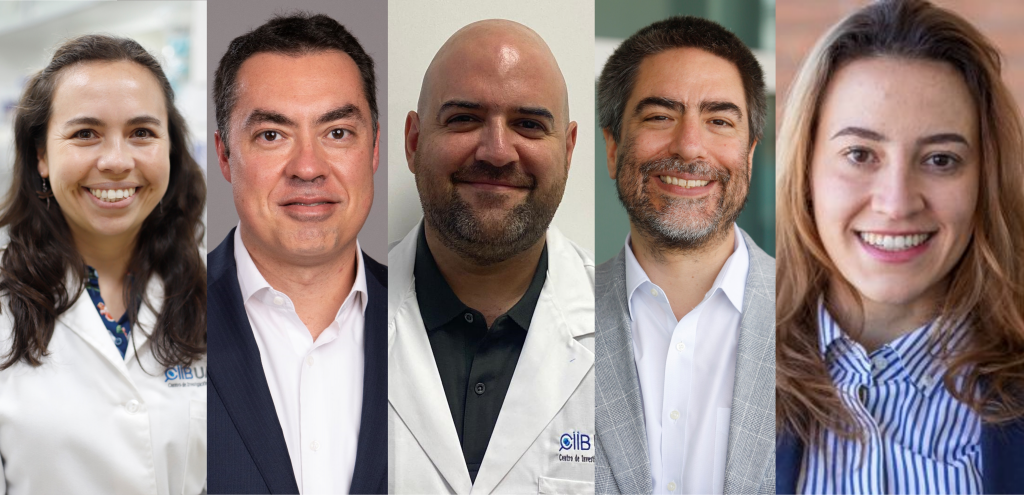
Fondecyt Postdoctoral Fellowship 2026
Through the Fondecyt Postdoctoral Fellowship 2026, researchers from Universidad de los Andes will develop projects in the areas of engineering, quantum communications, and regenerative biomedicine.
The awarded projects are:
- Álvaro Mattos (School of Engineering and Applied Sciences): Structural safety research, focused on analyzing the load-bearing capacity of steel anchors in concrete elements.
- Kei Sawada (School of Engineering and Applied Sciences): a project in the area of quantum communications, oriented toward the development of technologies for the secure transmission of information through atmospheric channels.
- Lina Anaya (School of Dentistry): a regenerative medicine study applied to oral health, through the development of a biomimetic scaffold for periodontal tissue regeneration.
The Directorate of Research and Doctorate noted that these results reflect the work of Universidad de los Andes academics in advancing research across different areas of knowledge, reaffirming the institutional commitment to research and researcher training.