
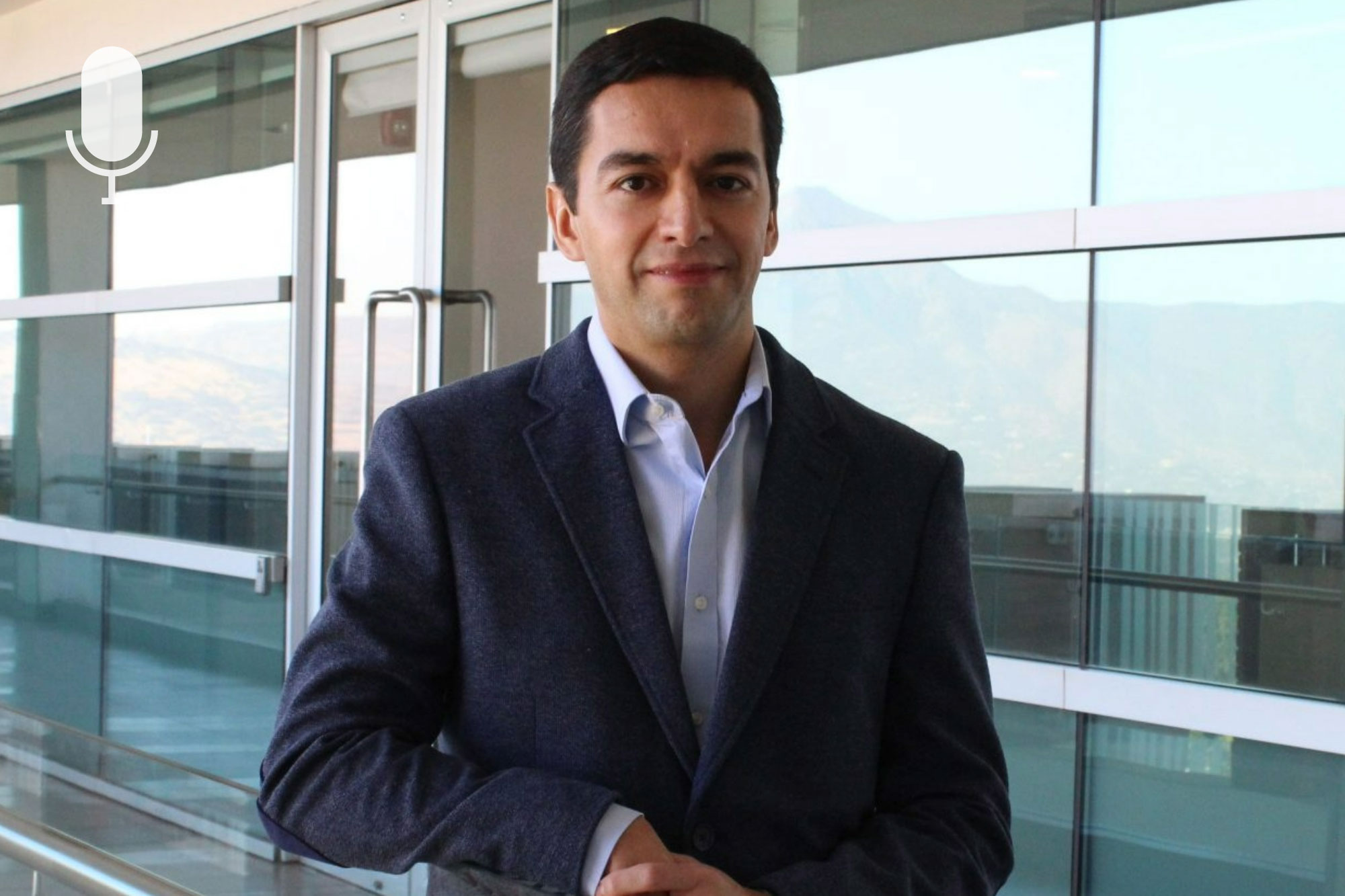
Juan Sotes, an academic from the School of Economics and Business Administration, studies how remuneration and valuation mechanisms affect mutual and pension fund investment decisions and their impact on price formation and market volatility.
The academic from the School of Economics and Business Administration,, Juan Sotesresearches how the incentives and constraints faced by large professional investors—such as mutual funds and pension funds—influence their investment decisions and how these impact the stability of financial markets.
The professor studies how the responses of professional investors to benchmarking —a mechanism that evaluates performance against market benchmarks—interact with the perceptions and emotions of retail investors. The research poses two main tasks: to develop a theoretical model to derive novel predictions and then to test them against real data. "One interesting aspect we have found is that, analyzed separately, certain types of emotions lead retail investors to make decisions similar to those induced by benchmarking in professional investors. However, when they interact, these decisions can generate dynamics completely opposite to those expected, helping us to explain aspects of the markets currently considered as puzzles," explains the academic.
Sotes's work is supported by a Fondecyt Regular grant titled "Remuneration tied to performance in financial portfolio management: explicit and implicit incentives, risk-taking and performance."This project analyzes the relationship between performance and the remuneration of professional managers, an aspect that has been little explored due to the private nature of their contracts. To do this, the academic and his team have a unique database with information on more than 1,800 European investment funds that apply performance-linked fees and nearly 37,000 additional funds that do not, over a ten-year period. These records make it possible to characterize the direct and indirect incentives that managers face, and how they influence their investment decisions and results.
Sotes's motivation for researching financial incentives goes back to his doctoral years in the United States, in the midst of the 2008 global financial crisis. "One of my professors at the University of Southern California (USA) was an expert in incentive design for corporate executives, and he taught us that the problems were not just about individual bad decisions, but were deeply linked to how compensation systems, rules of the game, and short-term pressures were designed. Since then, I set out to study with academic rigor how these incentives translate into investment decisions and, ultimately, into financial stability or instability," he said.
The findings of this line of research have a direct impact on the design of financial stability policies. "Our results help explain why markets appear less volatile in periods of optimism and more fragile in times of pessimism. Understanding that this relationship between sentiment and volatility is asymmetric can help regulators, central banks, and investment managers make better decisions,"says Sotes.
Likewise, his work contributes to the debate on the role of financial institutions, which can not only correct imbalances but also amplify problems or contribute to mitigating them. Ultimately, the research seeks to generate more stable and efficient conditions for the investment of people's savings.
The project has the collaboration of academics from universities in the following countries Chile, Australia, and Canada, wich gives it an international and multidisciplinary character.
At the same time, Sotes participates in other projects focused on the variable compensation in the financial industrya topic of wide debate worldwide. While its advocates argue that this scheme encourages maximum effort and better returns, its critics warn that it encourages excessive risk-taking that can have negative consequences for investors and the stability of the system.
Using data from European funds collected for Fondecyt, the team seeks to shed new light on this debate by analyzing how the balance between short- and long-term incentives affects portfolio performance and risk. Preliminary results show the importance of simultaneously considering direct incentives—such as current fees on assets under management—and indirect incentives, linked to future assets, to correctly identify these effects.
If you want to listen to this podcast, click here.