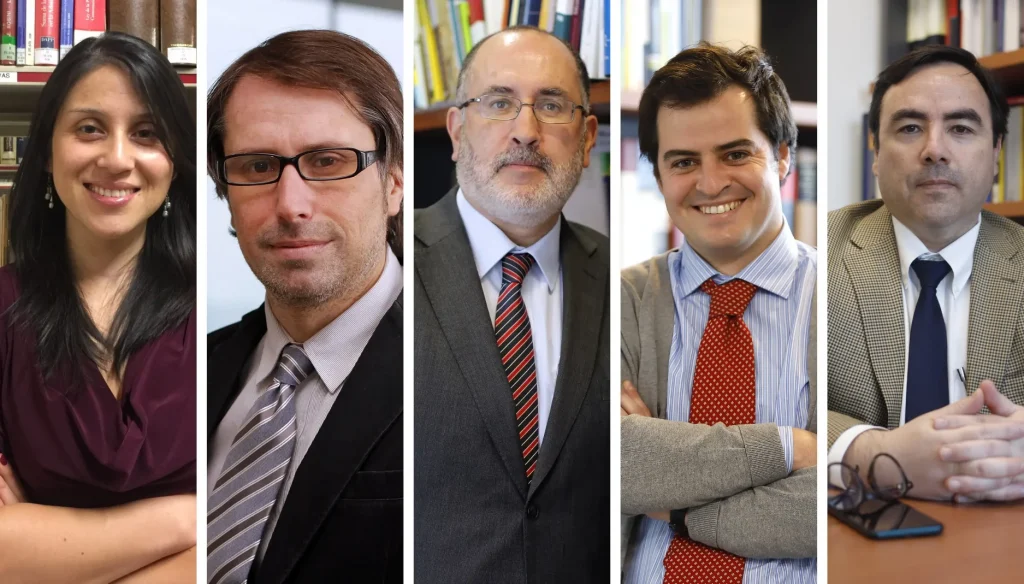

The selected initiatives address issues related to public, private, labor, and criminal law, with an impact on the functioning of institutions, the protection of workers' rights, and investment and economic development.
The School of Law obtained five funded projects in the Fondecyt Regular 2026 Competition, contributing significantly to the institutional total of 21 selected initiatives.
According to the results published by the National Agency for Research and Development (ANID) on January 23, 2026, UANDES achieved an award rate of 32.3%, with 21 projects selected out of a total of 65 applications, a performance consistent with the historical average of the national Fondecyt system.
In a context marked by a sustained increase in applications and greater competition among institutions,the results reflect the positioning of UANDES in strategic areas such as Biomedicine and Lawand the steady strengthening of academic research.
School of Law Projects Funded
The initiatives submitted by academics from the School of Law address central issues of public, private, labor, and criminal law,with a direct impact on institutions, the protection of rights, and economic development.
Rosa Fernanda Gómez leads the project "Dogmatic reconstruction of the sanctioning power of the Administration in Chile: foundations, principles, and balances,"which proposes a comprehensive analysis of administrative sanctioning law. The research seeks to overcome existing regulatory gaps and reduce the current dependence on criminal law categories, advancing toward a discipline with its own identity that reconciles the effectiveness of the Administration with the protection of fundamental rights. The co-investigator is Professor Daniela Rivera Bravo from Pontificia Universidad Católica de Chile.
For his part, Professor Pablo Manterola was awarded the project "Contributions in Professional Companies."The research critically examines the legal framework governing contributions in this type of company, analyzing the tension between the traditional concept of share capital and contemporary forms of investment, such as direct labor, reputation, or know-how, with the aim of proposing a conceptual reconstruction that better reflects the economic and organizational reality of professional companies. This initiative involves the participation as co-investigator of professor Manuel Bernet.
Professor Alejandro Romero heads the project "Arbitral partition of property as an obstacle to access to justice,"which examines the limitations of the current arbitral partition regime for small co-ownerships and highly fragmented estates.The study aims to design more cost-effective and expeditious mechanisms, incorporating simplified procedures with judicial supervision to facilitate the liquidation of jointly held assets and improve effective access to justice.
In the area of labor law, Alfredo Sierra leads the research "The Economic and Financial Participation of Workers in the Firm: Its Manifestations in Remuneration." The project analyzes different forms of participation in corporate results — such as bonuses, incentive payments, profit sharing, and stock compensation plans — aiming to contribute to the theoretical and practical development of labor law and to propose models that strengthen the motivation and commitment of workers
Finally, Professor Gonzalo García Palominos obtained funding for the project "Criminal Liability of Natural and Legal Persons in the Context of Corporate Groups: The Criminal Liability of Dominant Entities." The research addresses the complex problem of criminal responsibility in corporate structures composed of multiple companies,where decisions and their execution are distributed across different levels and entities of the group.
The study will analyze whether the current criteria of criminal law — both in its general provisions and in the areas of economic crimes and the criminal liability of legal persons — provide an adequate response to this phenomenon. Dr. Diva Serra (Universidad de Concepción) and Professor Dr. Lautaro Contreras (Universidad de Chile) participate as co-investigators.