From geology and engineering to urban planning and individual biographies, Uandes researchers addressed seismicity as a phenomenon that transforms the entire state and its inhabitants.
Understanding earthquakes beyond their physical dimension was the central theme of the meeting, organized by the Signos Center of the School of Social Sciences, the Center for Territorial Studies and the School of Engineering and Applied Sciences of the Universidad de los Andes.
The activity brought together researchers and professionals from different areas with the objective of analyzing seismicity as a phenomenon that crosses the territory, the institutions and the life trajectories of those who live in our country.
The day opened with welcoming remarks from Academic Vice Rector of the Universidad de los Andes, José Miguel SimiánHe stressed the relevance of generating spaces for interdisciplinary dialogue to address a phenomenon that is a structural part of Chilean history and experience.
The first panel, entitled "The earthquake as a complex natural and social phenomenon", proposed an initial approach to the phenomenon from the perspective of the construction of the State and the limits of scientific knowledge.
The opening was in charge of Patricio PliscoffD. in Ecology from the University of Lausanne, who presented a long term reading of the relationship between earthquakes and landscape in Chile.
From a historical and biogeographical perspective, he showed how seismic dynamics has been a structuring agent of the national territory, influencing the physical configuration of the country, in the distribution of its biodiversity and in the patterns of human occupation..
Through milestones in the development of scientific thought -from Charles Darwin's experience in Chile to the formulation of the theory of plate tectonics- he explained how the understanding of the planet as a dynamic system makes it possible to understand the uniqueness of the Chilean territory. In this context, he highlighted the role of subduction and the Andes Mountains in the conformation of Chile as a dynamic system. "biogeographic island"The ecosystems are differentiated and deeply marked by their seismic history.
The second presentation was given by Magdalena GilD. in Sociology from Columbia University and a researcher at the University of California at Berkeley. Pontificia Universidad Católica School of Government and of CIGIDENwho addressed the governance of risk in Chile's seismic history. In his presentation, he proposed understanding the State as a "great insurer", whose legitimacy is linked to its ability to protect the population against external and devastating threats.
Gil argued that Chile is a particularly interesting case: despite its peripheral location with respect to the major historical centers of development, it has built up a outstanding seismic risk management capabilities. This strength, he commented, is not only explained by the existence of anti-seismic norms, but also by a the broader socio-technical framework - institutions, oversight and compliance cultures - that make these regulations effective..
He also pointed out that reconstruction processes have historically been moments of expansion of state capacities, giving rise to institutions that last beyond the emergency.
The panel was closed by José Antonio AbellD. in Civil Engineering from the University of California, Davis, and a researcher at the University of California, Davis. School of Engineering and Applied Sciences of the Universidad de los Andes, who addressed earthquake prediction and risk analysis in contexts of uncertainty. Abell explained that, while prediction in terms of exact date, time and place remains unattainable, engineering has the tools to model damage and risk scenarios.which is key for decision making.
After the presentations of the first panel, a space for conversation between panelists and attendees was opened, moderated by Consuelo Araos, Signos Center researcherThe meeting was an in-depth discussion of the topics addressed and the scientific, institutional and social challenges associated with seismic risk management.
The second panel, entitled "From Catastrophe to Opportunity: Nature, City and Life Course," was moderated by. Pilar Giménez, director of the Center for Territorial Studiesand focused the reflection on the urban, social and biographical responses that emerge after major earthquakes.
The first presentation was given by Ángela Pradoarchitect, an expert in urban and territorial planning and researcher at the Center for Territorial Studies, who addressed the experience of the reconstruction after the earthquake and tsunami of February 27, 2010.
From his work in the Ministry of Housing and Urbanism, he stated that, in a highly urbanized country exposed to extensive risks, territorial planning cannot be based on exclusion, but on learning to live with risk..
He explained how the Urban Reconstruction Plan sought to balance the urgency of rebuilding housing with the need to safeguard urban quality, local identity, community participation and the environment. He highlighted instruments such as strategic sustainable reconstruction plans, urban regeneration plans and the updating of regulatory plans with risk studies, stressing that many of these advances were possible thanks to exceptional regulatory frameworks. Fifteen years after February 27, he warned, the challenge remains to consolidate these lessons learned and to prevent planning from once again relegating risk to the background.
The second presentation provided an international perspective from a local management perspective. Elenka Jarolimek, emergency manager from the city of Seattle (United States), presented how a coastal municipality in the Pacific coast of North America prepares for a possible catastrophic earthquake.
From practical experience, he explained that Seattle faces seismic hazards comparable to those in Chile and that its planning is oriented towards functional recovery, understood as the rapid restoration of the city's essential functions.
One of the central themes of his presentation was the incorporation of social equity in risk planning. Through the GeoEquity Planning project, he showed how the crossing between seismic damage models and demographic data allows the identification of areas where social vulnerability and physical risk overlap, guiding preventive actions, urban development decisions and targeted communication strategies.
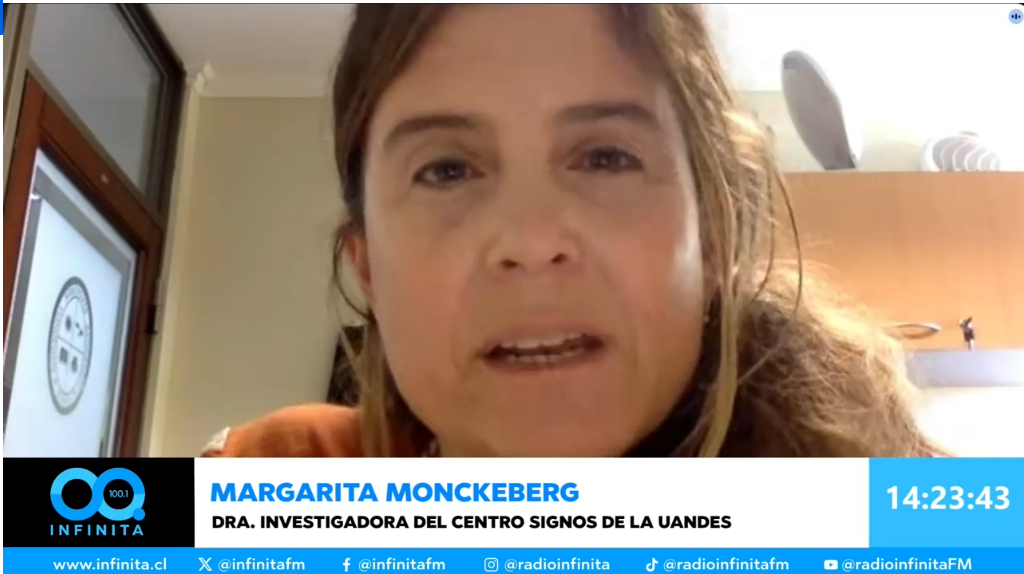
The panel was closed by Margarita MonckebergD. in Communication from the Universidad de los Andes and postdoctoral researcher at the Signos Center, who proposed looking at the earthquake as a biographical milestone.
Starting with the case of the 1960 Valdivia earthquake, he explored how catastrophe fractures not only cities and landscapes, but also memories, family decisions and life trajectories..
Monckeberg collected historical accounts and personal testimonials to show how earthquakes have shaped a telluric memory in Chile and dwelled on lesser-known episodes of the 1960 disaster, such as the sea evacuation of children from Valdivia and Corral.