
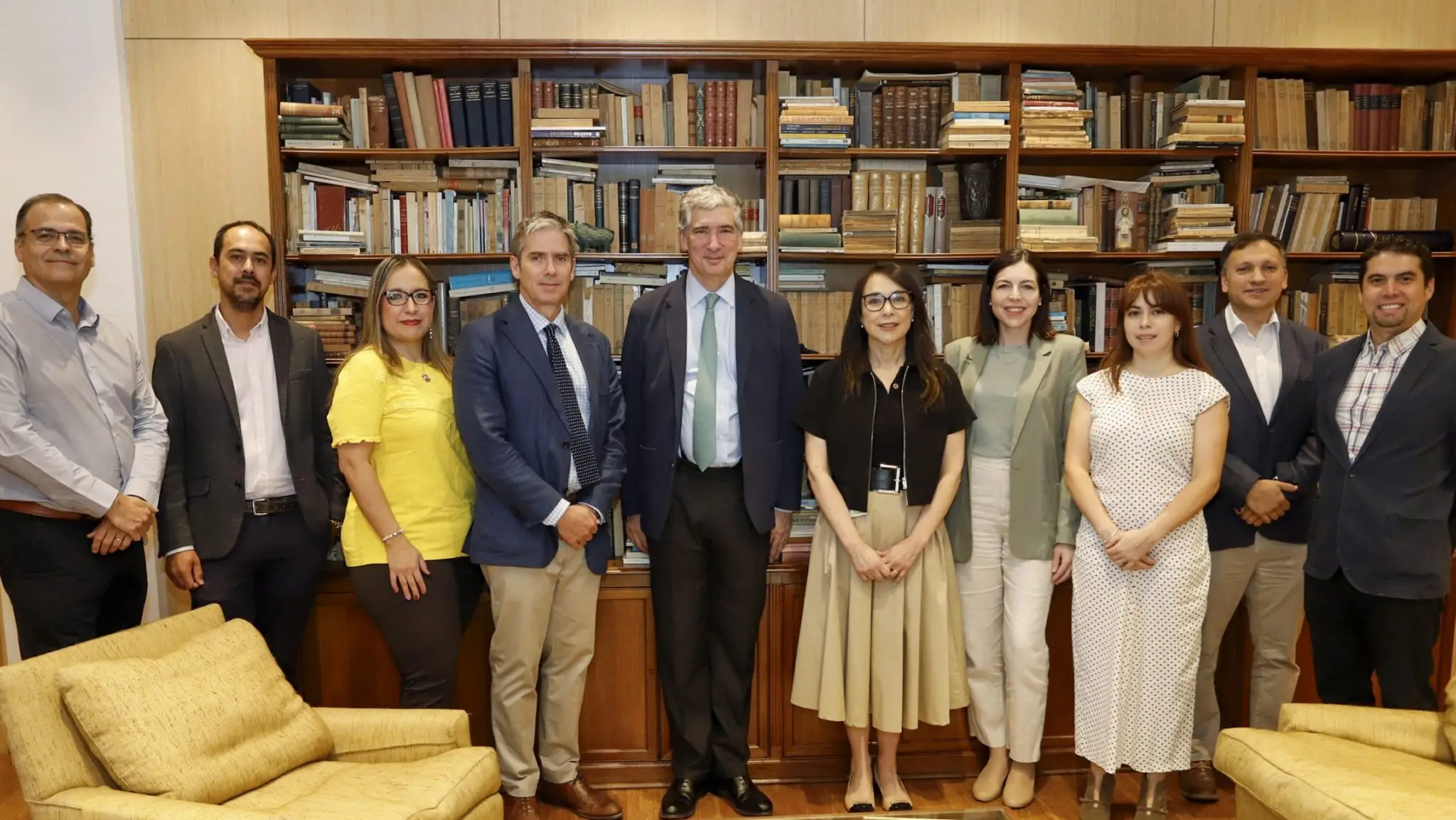
The meeting reaffirmed that the development of UANDES research should be oriented toward the search for truth, the training of students, and the projection of academic talent in a university of excellence with a view to the future.
On January 19, the UANDES Research Council shared with Rector José Antonio Guzmán an assessment of the work carried out during 2025 and the main strategic challenges for the period ahead.
Those present included the Vice Rector for Research, Javier Enrione; the Director of Research and Doctoral Studies, Claudia Brizuela; the Deputy Director of Research, Daniela Bonacic; and Council members Federico Batiz (director of the CIIB), Felipe Scott, Rosa González (School of Engineering and Applied Sciences, joining the Council), Ana Elisa Pereira (School of Economics and Business Administration), José Antonio Giménez (Institute of Philosophy) and Joaquín Zuleta (Institute of Literature).
The meeting was held as part of the process of Institutional Strategic Planning (PEI) and addressed, as cross-cutting issues, the alignment with teaching and the need to preserve the educational identity of Universidad de los Andes.
"Delicate Balance" and Guidelines with Flexibility
At the beginning of the meeting, the Rector stressed the need to maintain the "delicate balance" between research and student training, emphasizing that teaching must remain at the center of decisions and that people are the foundation of academic development.
"This year the Council has a special challenge: to help define a research strategy for the University's PEI," he noted, regarding the importance of defining stable directions without losing the capacity for innovation.
Guzmán also stressed the need for flexibility to innovate within stable guidelines, citing a reflection inspired by Cardinal John Henry Newman: "Rivers are strong when they have solid walls on the sides. Clear guidelines give us direction and strength.".
Key Role of the Council: From Operational to Strategic
During 2025, the Research Council played an advisory role to the Office of the Vice-Rector for Research, with a deliberate shift toward structural and forward-looking issues. In her presentation of the annual review, Claudia Brizuela explained that the Council transitioned from a more operational agenda to strategic conversations: "This year we wanted to reorient the Council's work: to move from the more operational to a more strategic perspective, with a focus on sustainability, talent, and relevant excellence with future projection," she said.
Topics addressed included criteria for excellence and productivity by discipline, funding sustainability, strengthening internationalization, review of incentives in the Humanities, and the design, implementation, and evaluation of the Strengthening Program for Research Excellence.
One of the central themes of the work was the recognition of disciplinary differences and the need to develop differentiated frameworks that maintain high quality standards while respecting the logic of each field of knowledge.
In this context, the Rector reinforced the need to consider the impact of emerging phenomena, such as artificial intelligence as applied to researchand their normative, ethical, and methodological implications.
Financing, Excellence, and Long-Term Vision
Another priority addressed by the Council in 2025 was the structural crisis in research funding, marked by the stagnation of the public budget and high dependence on competitive funds such as Fondecyt. The analysis led to the conclusion that this situation is not cyclical, but rather requires a long-term institutional strategy, with the objective of strengthening internal capabilities, improving competitiveness, and diversifying funding sources.
The Vice Rector for Research, Javier Enrione, engaged with this reflection from a strategic perspective, emphasizing the need for institutional funding criteria consistent with Universidad de los Andes’s identity.
Enrione also invited the Council to envision the development of research over a medium and long-term horizon. "The Council must ask itself how it envisions the University in 5 or 10 years' time," he said, also reflecting on the model of research centers and collaboration among researchers.
Strengthening and Incentive Programs in the Humanities
The 2025 report also monitored and evaluated the Strengthening Program for Research Excellence, whose first implementation yielded key lessons. Among them: the importance of better strategic alignment between academic units and researchers,and the need to incorporate institutional and colaborative criteria in the selection of projects.
In parallel, the Council reviewed the incentive structures in the Humanities, proposing to recognize the book as a central product of excellence, without overlooking the importance of publication in high-impact journals. Given its strategic and budgetary significance, this proposal was submitted to the Rector's Office.
During the meeting, Council members also shared reflections on the work carried out and future challenges, highlighting the value of interdisciplinary dialogue.
From the humanities, Joaquín Zuleta highlighted the breadth of perspectives on excellence, stressing that the Council has sought to make disciplinary specificity compatible with institutional objectives.
Felipe Scott, who will be succeeded on the Council by Rosa González, addressed the sustainability of the system, noting that "it is worth questioning who could survive with sustainable funding that does not depend on public resources. Identifying talent and building groups or centers is key, but it is not easy."
The meeting closed by reaffirming that the development of research at Universidad de los Andes must be oriented toward the search for truth, contributing to strengthen the formation of students, projecting academic talent, and building, with institutional purpose, a university of excellence with a view to the future..