
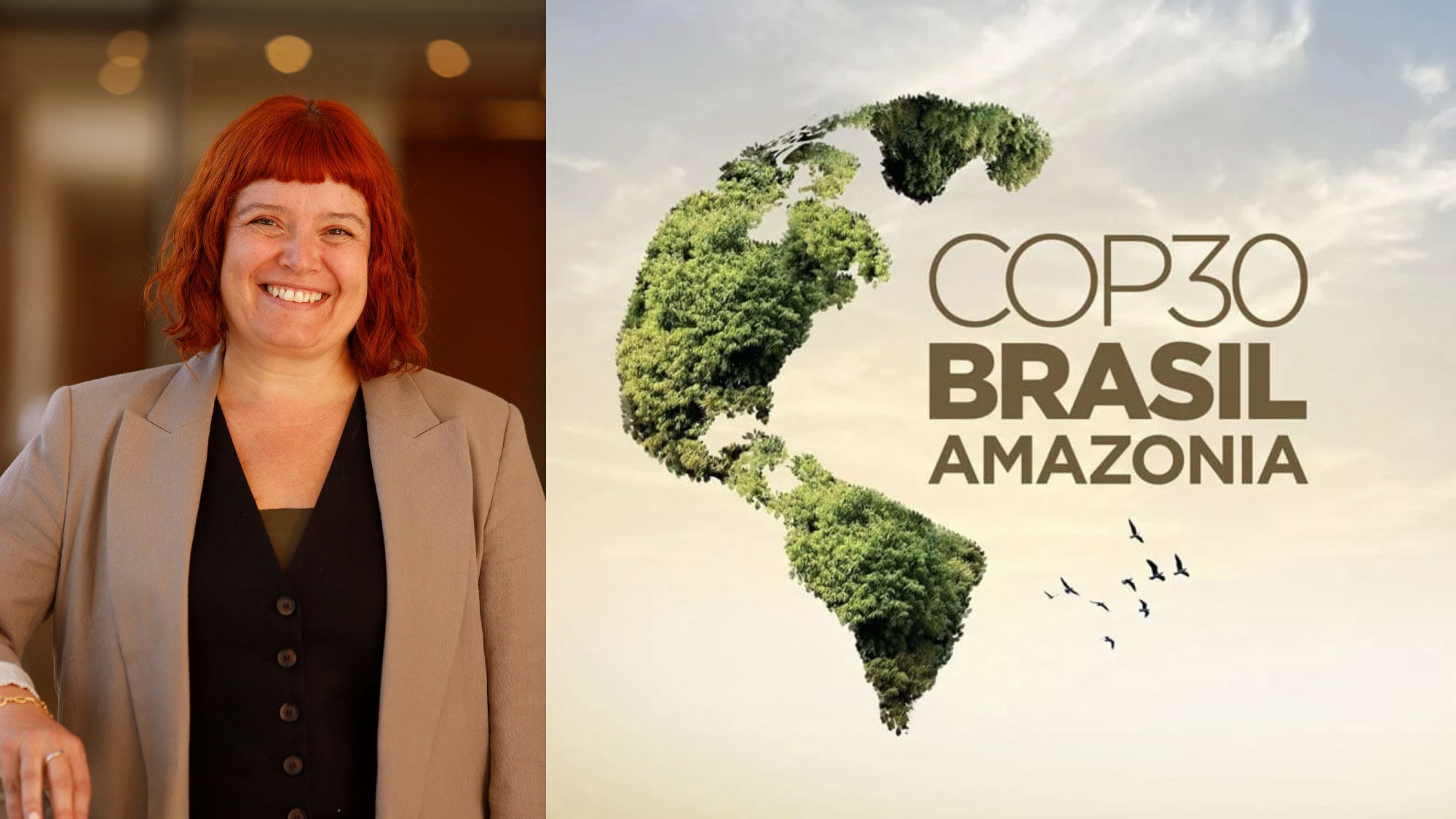
Cynnamon Dobbs states that the Center for Territorial Studies seeks to promote the use of nature in health issues, generate robust evidence, and actively participate in the development of green infrastructure plans derived from the Green Cities Strategy in Chile.
Latin America and the Caribbean are positioning themselves as world references in the implementation of Nature-Based Solutions (NBS), an approach that integrates the protection of ecosystems, the implementation of green infrastructure, and ancestral knowledge to face climate challenges in cities.
This was emphasized by the researcher of the Center for Territorial Studies (CET) of Universidad de los Andes, Cynnamon Dobbswho participated on Thursday, November 20, in the COP30 held in Brazil, where she presented the regional advances in this area.
In the delivery of the results of the Global Synthesis Report: Global Roadmap for Urban Nature-Based Solutions (NBS)Dobbs stressed that these strategies not only address the looming challenges posed by climate change, such as flooding, water scarcity, and heat waves, but also promote social cohesion, economic well-being and inclusion.
The region has a long history of using nature to solve urban problems, with the most common types of NBS being green spaces, urban forests, and urban wetlands.These have recently been frequently supported technically and financially by international organizations.
A notable example of an NBS in Latin America for water harvesting is the use of the ancestral technique of amunas in the outskirts of Lima, Peru. The amunas were used by the ancient Inca communities and consist of natural containers located in the ground, which capture rainwater and then conduct it through the subsoil, allowing the aquifers to recharge. This process known as "water seeding" has allowed the infiltrated water to benefit both agricultural and livestock communities as well as the people of Lima.
In this way, Dobbs stresses, the knowledge of local, rural, indigenous, and migrant communities is integrated, thus contributing to forging a Latin American identity around these practices.
The reception of the results of the study that Cynnamon Dobbs led, according to her, was very positive, due to the possibility of comparing common patterns with other regions of the world and highlighting particularities of the continent.
Dobbs emphasized that NBS in Latin America are primarily responding to challenges linked to climate change; however, these solutions are also intertwined with structural problems, such as urban inequity, biodiversity loss, housing deficits, informal settlements, and land ownership.
"We need to better communicate how these solutions can address multidimensional vulnerabilities," She argued.
Monitoring and evidence: key to the success of NBS
A crucial point made by the CET researcher in her presentation was the need to invest not only in implementing these solutions, but also in their monitoring and evaluation, to measure their ecological, social, and economic impacts. This evidence is key to adjusting interventions and comparing them with traditional alternatives, said the UANDES researcher.
Dobbs also stated that it is necessary to strengthen the spaces for exchange between cities in order to consolidate learning and good practices.
Regarding the expansion of the concept, Dobbs noted that the NBS "are gaining more and more traction," exemplified by the recent approval in Chile of the Green Cities Strategy by the Council of Ministers, and the progressive incorporation of the approach in countries such as Brazil, Colombia, and Peru.
Her projection is that this form of integrating nature into cities "will grow rather than diminish".
This momentum has also positioned the UANDES Center for Territorial Studies "at the forefront" among research centers dedicated to the study of NBS at the national and international level.
When asked about the development of COP30, Dobbs pointed out that the negotiations "are still very difficult," and although there is some progress in reducing emissions, "it is still not enough". She stressed the need for greater efforts and investment in mitigation, as well as stronger collaboration between countries, despite the fact that various private and public institutions and foundations are already committed to climate change adaptation.
As for what's next for CET, Dobbs said that the team seeks to further enhance the use of nature in health issues. The objective is to generate robust evidence and actively participate in the development of green infrastructure plans derived from the Green Cities Strategy in Chile, with the objective of supporting the integration of nature in the national territory.