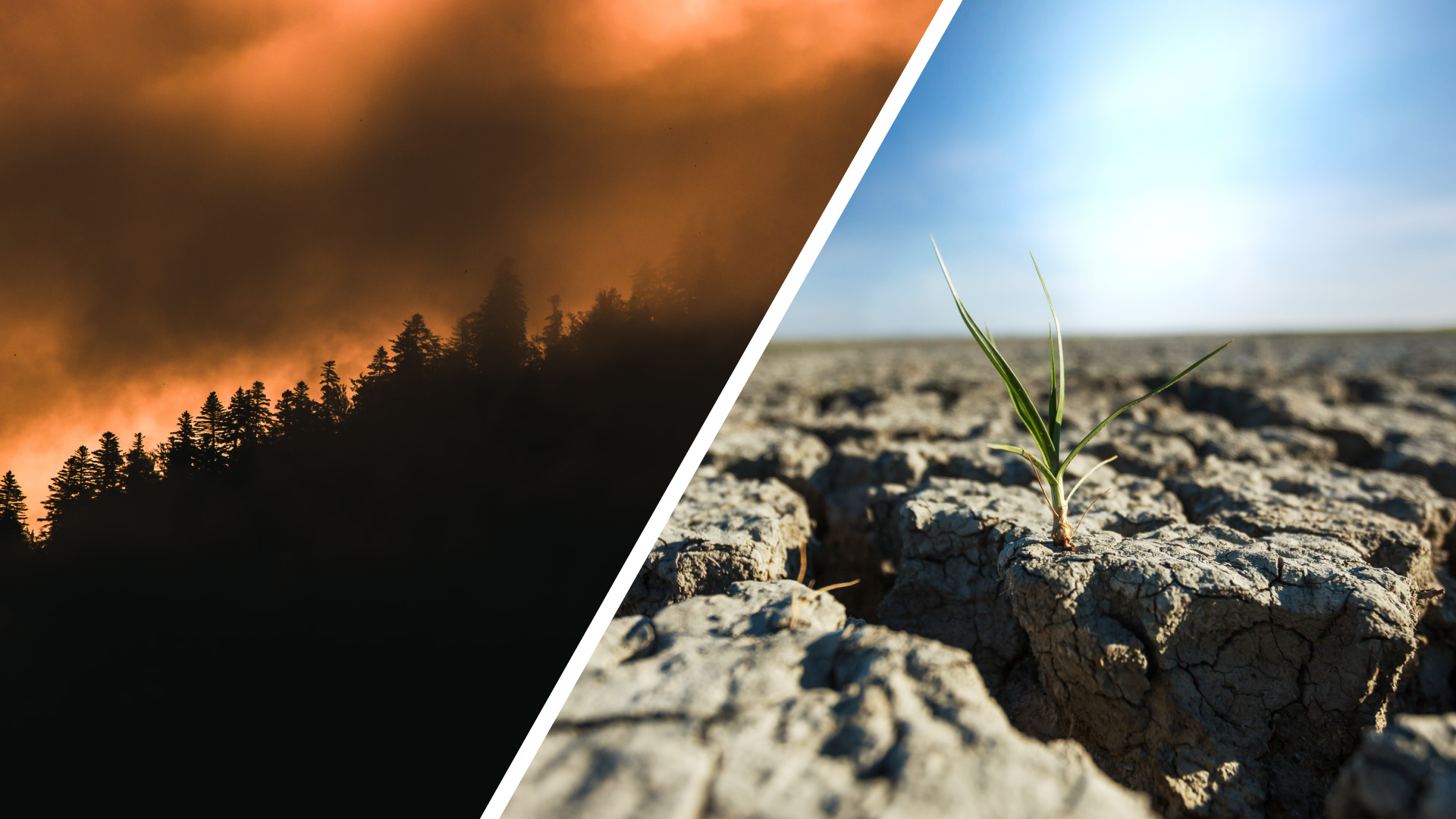
Marcel Favereau from the School of Engineering contributed to a collective book on the drought in Chile, and Agustín Donoso from the School of Communication will develop a project to cover forest fires.
Marcel Favereau, a professor in the School of Engineering and Applied Sciences at the University of the Andes, contributed to a collective book on the drought in Chile and, at the same time, received an international award for his research on reservoir management, at a time when the water crisis remains one of the country’s main challenges.
Key findings:
- A book offering a multidisciplinary perspective on drought. Favereau is one of about 40 researchers who participated in Droughts in Chile: Impacts, Monitoring, and Adaptation Policies (also in Spanish as Droughts in Chile: Impacts, Monitoring, and Management Policies), which analyzes the phenomenon from the perspectives of engineering, law, economics, geography, and agronomy, focusing on three areas: the national context, comparative experiences, and public policy proposals.
- His specific contribution It was a chapter—co-authored with five other researchers—on how to integrate the operation of multipurpose reservoirs (irrigation and power generation), taking into account both the watershed and the large-scale power system.
- International award for his line of research. The same scholar is leading the study Evaluation of Multipurpose Reservoir Operating Policies at the Basin and Electric Power System Scales, recipient of the 2025 Best Research-Oriented Paper Award from the Journal of Water Resources Planning and Management.
- The underlying objective is to develop optimization and stochastic modeling tools that help manage water more efficiently when sectors such as energy and agriculture compete for its use—a scenario that is becoming increasingly common in Chile.
- Outlook for the future. According to Favereau, this recognition strengthens the potential for new research and interdisciplinary collaborations, and helps promote studies that support decision-making in highly uncertain scenarios, such as those related to drought and climate change.
José Agustín Donoso will lead “Facing the Fire: Stories of Resilience and Innovation in the Fight Against Wildfires in Ecuador and Chile,” an international collaboration project (COIL) between the Universidad de los Andes and the Universidad de los Hemisferios (Ecuador), in which students from both countries will co-create a transmedia website.
Key findings:
- Ten stories, two countries. The project will document five stories in Chile—including robotic cameras with artificial intelligence at the Costanera Tower that detect smoke plumes early on, a predictive algorithm developed by researchers at the University of Chile, virtual reality training for firefighters, and the use of strategic goat grazing to reduce fuel load—and five in Ecuador, including the Quito Fire Department’s AI-powered monitoring center and the work of community fire brigades in the Andean Chocó.
- The COIL Methodology: connects students from both countries so they can work virtually and collaboratively on a shared project, developing skills in globalized multimedia production and active, project-based learning.
- Academic and Expert Team: In addition to Donoso (a documentary filmmaker with experience in award-winning medium-length and short films at festivals), Diego Ortiz Jaramillo, director of the Media & Innovation Lab at Hemisferios University, will also participate. Guests include Isabel Alarcón, an environmental journalist who has been published in The Guardian and the BBC, and Felipe Saavedra, editor-in-chief of the newspapers *La Estrella de Concepción* and *Crónica Chillán*.
- Background Leading to the Project: In Ecuador, the fires of September 2024 left 412 hotspots and 2,560 hectares burned—the highest figure in six years—mobilizing more than 200 volunteers in a community reforestation “minga.” Between 2010 and 2025, the country recorded more than 32,800 wildfires, affecting more than 336,000 hectares, which led the government to launch its first National Strategy for Comprehensive Fire Management as recently as 2025.