

The platform created by the Center for Territorial Studies and the School of Engineering seeks to optimize the management of building permits, allowing a more agile and accurate review of the application files. The prototype was a finalist in the contest held by Laboratorio de Gobierno and the IDB.
Is it possible to make the analysis, processing, and obtaining of building permits simpler and more effective, thus optimizing time and effort?
For the team of the Center for Territorial Studies (CET) and the School of Engineering and Applied Sciences UANDES , it is possible.
How? Through DOMus AI, a platform that puts artificial intelligence at the service of the processing of building permits to be granted by the Municipal Works Directorates (DOM).
This innovative tool is not only intended to be an academic prototype but was also a finalist in the contest " Impacta GovTech: Building Permits," developed by the Laboratorio de Gobierno of the Ministry of Finance, together with the Inter-American Development Bank (IDB), the Ministry of Economy, and the Ministry of Housing and Urban Development (MINVU).
This innovation contest seeks to find solutions to the challenges associated with the processing of building permits, from development to subsequent piloting. This will allow testing technological and management solutions that can improve processing times, traceability, and the processing experience.
The Municipal Works Departments (DOM) are currently facing slow and complex processes in the processing of building permits due to the manual review of regulations and background information.
DOMus AI seeks to optimize this management through an artificial intelligence system that supports the analysis and application of regulations, especially through the instructions provided by the circulars of the Urban Development Division (DDU), allowing a more agile and accurate review of the application files. With a simple and accessible interface, the system will strengthen the connection with MINVU, improve decision-making, reduce time and costs in the review of Building Permits, and increase legal certainty in the processes.
What is DOMus AI and how does it work?
Ángela Prado from the CET explains that this platform is structured as a "regulatory library"; that is, it brings together the General Law of Urbanism and Construction and its respective ordinance, as well as a multiplicity of interpretations made through DDU circulars and opinions of the Comptroller General of the Republic on urban planning matters, which are necessary to support the work of the Municipal Works Directorates.
Prado emphasizes that the prototype "assists" the architect reviewers within the DOM and does not replace them. In the long term, it seeks to broaden the audience, in the sense that although it was created as a support to the DOM, it is a tool that can also be used by private companies, specifically those who prepare building projects.
The joint project between CET and the School of Engineering is structured in two stages. The first one incorporates all the documentation related to the General Construction Law and its Ordinance together with the interpretations of different organizations related to these same norms. The second stage related to a project in a specific territory where it is necessary to incorporate the territorial variable through the different Territorial Planning Instruments (IPT). In Prado's words, in the first stage, the general norms are seen, and in the second stage, the territorial variable is incorporated through the Communal and Intercommunal Regulatory Plans.
Thanks to the project developed for the fund in which DOMus AI was a finalist, we were able to develop only the first part, leaving the second part for a later stage.
"Within the platform is the possibility of creating a folder for a specific project within a DOM and having several officials work on the same project, which would be the building permit application file, but obviously it lacks incorporating everything that is territorial planning, which is the other subset of urban planning rules that applies to a particular property," she explains about how it works.
She adds that this first stage was co-created with the municipalities of Renca, Las Condes, Viña del Mar, Lo Barnechea, and Maipú, among others, which will benefit from its implementation process.
"We stayed at the formulation stage, but without the general testing of the Work Directions," says the CET researcher.
But, specifically,how does DOMus AI work? Matías Recabarren points out that the platform analyzes all versions of all articles of the General Law of Urbanism and Construction (LGUC) since its first publication in 1976, and all versions of all articles of the General Ordinance of the LGUC (OGUC) since its promulgation in 1992.
In addition, it analyzes more than 500 circulars issued by the Directorate of Urban Development (DDU) of the Ministry of Housing and Urbanism and the rulings issued by the Comptroller General of the Republic (CGR) in the context of Urbanism since 2020, thus constituting a "regulatory library."
This repository makes it possible to have clarity regarding which norms must be applied in each project and what interpretations can be made. It also helps to order the circulars of the Ministry of Housing and Urbanism and the opinions of the Comptroller's Office, all in accordance with the General Urbanism Law and its ordinance for the review made by the officials of the Works Directorate when building projects are presented.
Subsequently, the Works Directorate has to contrast it with all the territorial planning, so the idea for the future is to continue developing the prototype.
The CET researcher explains that this innovation works in a very similar way to ChatGPT; that is to say, "what it basically does is that the officials ask about the general regulations applicable to the approval of a building permit, with some indication or with such characteristics, and this assistant provides the applicable regulations at the level of LGUC and OGUC, in addition to all the DDUs that have spoken about these regulations and all the opinions related to the matter."
It also details that the system can continue to elaborate answers as the user needs more depth or clarity, as is the case with conversational chat programs based on generative artificial intelligence.
"It helps the civil servant to know which are the regulations, which are the most relevant circulars for his response to observations, to guide him and to support him. It is a research project at the service of society, because it is born from a problem imposed by society and what we do as a university is to put our capabilities at the service of this solution," complements Recabarren.
Prado explains that after being finalists in the IDB and MINVU competition, they will now seek to apply for another fund to continue, "so the idea is to be able to address it in its entirety."
UANDES backing behind DOMus AI
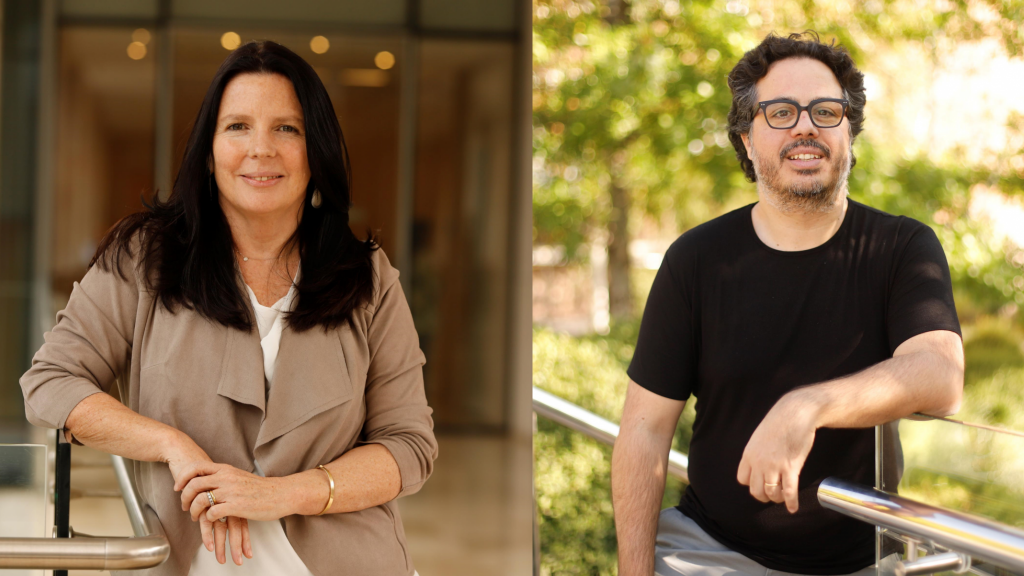
Matías Recabarren is a regular associate professor at the Shool of Engineering and Applied Sciences of UANDES and director of this research. He was joined by Ángela Prado, deputy director of CET-UANDES and an expert researcher on the subject. They are joined by Carlos Díaz, Julio Cortés, and Cristián Concha, alumni of the Faculty of Engineering and Applied Sciences, together with a multidisciplinary team of academics, researchers, and alumni experts in software development, artificial intelligence, and human-computer interaction. Together with them, the team of the Center for Territorial Studies was dedicated to the study of territorial sustainability and its relationship with people.
In the opinion of the creators, the major problem with the building permit approval process is the lack of legal certainty, since when the regulations are left open to multiple interpretations, everyone loses: conflicts increase, as do judicialization, delays, frustration, and, above all, the public's distrust of the institutions.
Why is this project important for Universidad de los Andes?
"Because the university is committed to contributing to society by researching complex and relevant problems.Permit processing was the big issue of 2024, and this project allowed us to link directly with a real challenge of the country. Without forgetting that we are part of a university that connects us with research, talent, and experts from different areas to continue scaling this solution."
The financing model granted by the Inter-American Development Bank has a total budget of up to USD 130,000 to be distributed through the different stages and according to the progress of the teams.
Learn more here by Matías Recabarren
Learn more about DOMus AI here by Ángela Prado