
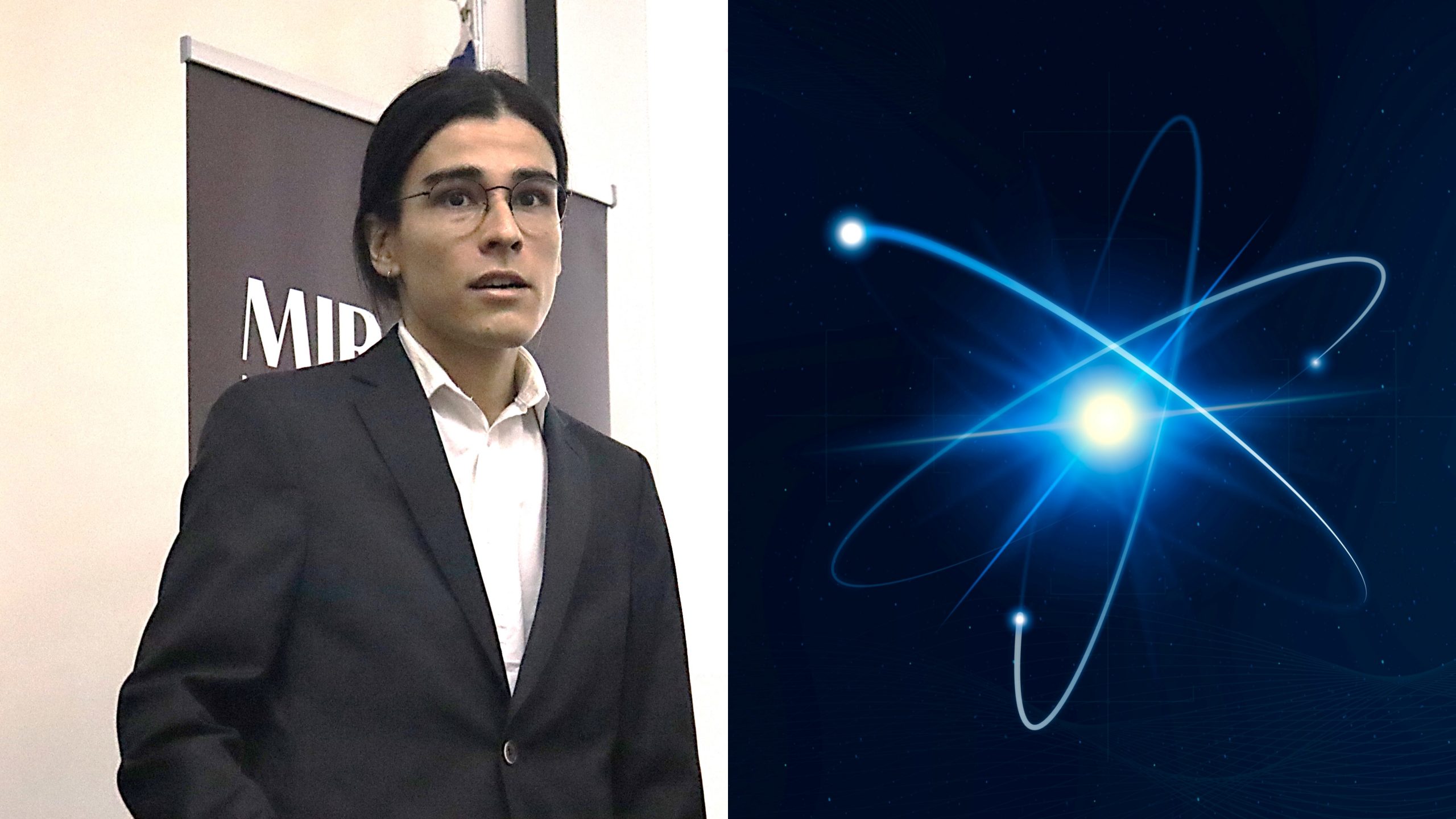
Creating communication systems in which information is transmitted wirelessly in encrypted form and cannot be tampered with is the central objective of the research being carried out by a group of UANDES researchers.
Led by Kei Sawada, a researcher and faculty member at the School of Engineering and Applied Sciences, this cutting-edge technology development was awarded funding through the Fondecyt Postdoctoral Fellowship 2026.
"The project aims to lay the foundation for more secure quantum wireless communication systems by incorporating adaptive optics, a technology that actively corrects the distortions that occur when light propagates through the atmosphere by precisely controlling elements such as mirrors," explains Sawada.
"In simple terms, this line of research proposes to send information not through radio waves, as in current telecommunications, but through photons, the elementary particles of light. The information can be encoded, for example, in the arrival time of a photon: if it arrives earlier, it is interpreted as a 0, and if it arrives later, as a 1, thus allowing complete digital messages to be transmitted."
The great advantage of this approach is its security, Sawada explains, since the laws of physics prevent the exact replication of a quantum state. Any attempt at interception introduces noise into the system and immediately reveals the intrusion.
The urgency of advancing these technologies becomes especially apparent in the face of the accelerated development of quantum computers around the world. In the future, these machines could be capable of breaking current encryption systems.
"Quantum communication, on the other hand, is intrinsically secure even in this scenario, so building local capabilities and anticipating these risks is key for the country. In addition, there is concern that encrypted information is being stored today only to be decrypted when the technology permits it, which reinforces the need to protect communications proactively," he says.
The research is being carried out in collaboration with full professor of the School of Engineering and Applied Sciences, Jaime Anguita; postdoctoral researcher Nelly Cerpa; doctoral students Carlos Pirela and Andrés Seguel ; and Master's student José Pablo Durandeau.
The applications of this research go beyond the security of government, corporate, and personal telecommunications. The transmission of quantum states opens the door to distributed quantum computing, where computers in different locations can operate collaboratively. Similarly, the same environmental disturbances that hinder communication can be harnessed in high-precision quantum sensors and radars.
In the scientific domain, these tools could even enable new fundamental experiments on quantum systems under the influence of gravity, a longstanding challenge in modern physics.