
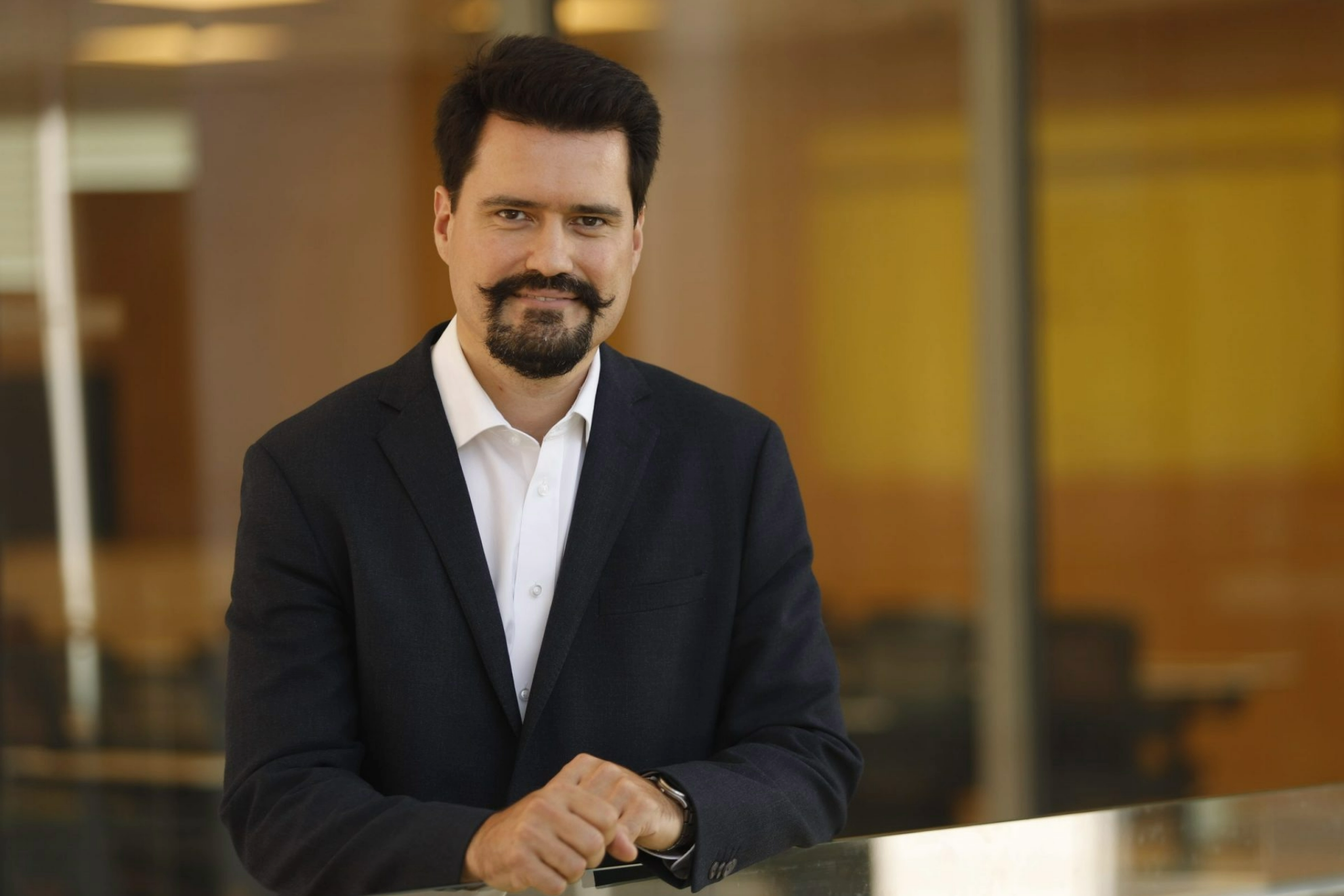
The academic Claudio Alvarez seeks how to integrate ethical micro-insertions in engineering, business and medicine careers, supported by collaborative digital platforms such as EthicApp, in order to train professionals capable of making responsible decisions in real contexts.
The academic from the School of Engineering and Applied Sciences Claudio Álvarez is leading a line of research that combines digital technologies and collaborative pedagogical structures to teach ethics in an integrated, applied and transversal way in higher education. "I come from the world of engineering and computer science, and since my PhD I have worked on designing digital environments that guide students in complex collaborative learning processes. Over time I understood that those same tools could be used for an even greater challenge: teaching ethics. It's not enough to know how to program or solve equations; you also have to know right from wrong and make responsible decisions in real-world contexts."explains Alvarez.
From this reflection arose the concept of ethical micro-insertions: short pedagogical interventions that are directly integrated into disciplinary courses - such as finance, management control, software engineering or artificial intelligence - to link technical content with real ethical dilemmas. Rather than teaching ethics as a separate course, this approach seeks to have students discuss, argue and make informed decisions in situations specific to their future profession. "In many engineering majors, students have one or two ethics courses in their entire education, with very few credits. But ethical competence-like any complex skill-doesn't develop with an isolated class. It requires practice, repetition and context," he says.
The project draws inspiration from international experiences such as the Harvard Embedded EthiCS, where philosophers and computer science academics work together to incorporate ethical dilemmas into technical subjects. In the Latin American case, Alvarez has sought to adapt and scale this model with an interdisciplinary and sustainable approach, where ethics teachers and technical area teachers design collaborative activities together.
A key component of this research is EthicAppa platform created to facilitate ethical discussion in professional training contexts. The application guides students through step-by-step pedagogical scripts that promote ethical reasoning and peer debate, allowing them to reflect on contextualized dilemmas in engineering, business and medicine. Currently, the team is working on a new phase that incorporates generative artificial intelligence in order to provide automated feedback to students and support teachers in the evaluation and monitoring of these processes.
This project was awarded a Fondecyt Regular 2019and co-authored by University of Chile academics Gustavo Zurita, Nelson Baloian and Óscar Jerez. Since then, it has expanded through an international network with institutions in Spain (Universidad de Valladolid, Universidad Pompeu Fabra), Ecuador (UTPL), Mexico (BUAP, Universidad Panamericana) and Colombia (Universidad del Cauca), among others.
Alvarez's approach differs from traditional ethics courses in three ways: it is integrated into disciplinary courses, it is active and collaborative, and it is supported by technology that structures ethical debate. "We want to train graduates capable of recognizing ethical dilemmas, discussing them critically and acting responsibly in environments where technical, organizational and social factors converge. We want students to constantly face dilemmas and discussions in real contexts, integrating ethical reflection as an essential part of their training. This means that ethics will cease to be an implicit or marginal learning, and will become a visible, recognized and valued component of the educational process," says the academic.