

In her presentation, the Director of Research and Doctoral Programs at Uandes highlighted how inter-university collaboration has strengthened trust and achieved measurable results in research, training and links with the environment.
With a call to strengthen research networks between public and private institutions, Claudia Brizuela, Director of Research and Doctoral Studies at the Universidad de los Andes, participated in the second version of the "Research and Doctoral Networks" conference.Quality Culture CNA 2025: inter-institutional collaboration and linkage with the environment".organized by the National Accreditation Commission (CNA).
The event was attended by the CNA's Director of Quality Promotion, Daniel Casanova, together with commissioners and representatives of various universities in the country, reaffirming the collaborative nature of the meeting.
The activity is of strategic importance for the quality assurance system, as it reflects the spirit of collaboration that the CNA seeks to consolidate with the country's higher education institutions.
The director of Research and Doctorate referred to the importance of this CNA discussion to learn about the different perspectives and experiences related to quality assurance, especially in research and linkage with the environment.
"These instances make it possible to make tangible the interaction between a regulatory body, such as the CNA, and the reality of each institution. They are spaces that encourage active listening and dialogue with the community, avoiding losing the foundational aspects that give identity to each university," said Claudia Brizuela.
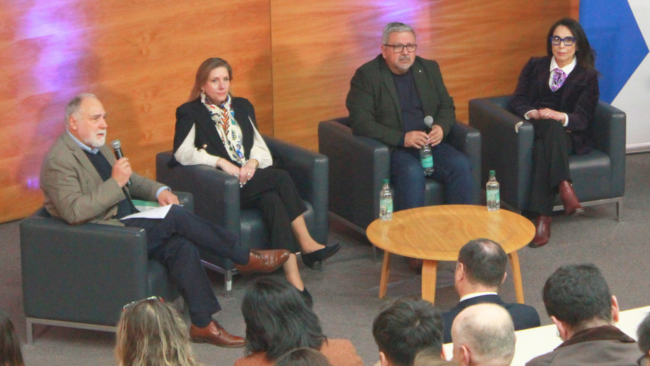
From competition to cooperation: networked research with impact
In his presentation, entitled "From collaboration to trust: keys to strengthen inter-institutional research networks with impact".The Director of Research and Doctoral Programs at Uandes highlighted how inter-university collaboration has strengthened trust and achieved measurable results in research, training and links with the environment.
Among the achievements that Brizuela presented to the CNA, he highlighted the Inter-University Network for Associative Research, of which Universidad de los Andes is a member, together with eight other universities.
Working on the basis of trust, this entity has focused on collaborative projects, which allows sustainable co-authorships with social impact, in various areas of knowledge.
An example of this is the 29 projects awarded and financed through the three editions of the Inter-University Competition for Initiation in Associative Research, for an amount of $360 million between 2022 and 2024.
One of them was the project that measured how environmental temperature, associated with climate change, produces variations in the weight of newborns, carried out jointly by researchers from Universidad Mayor, Universidad del Desarrollo and Universidad Andrés Bello.
This network is complemented by the bilateral Seed Funds, which seek to finance research that solves real problems in the territories. This alliance of Uandes with the UFRO and the Universidad Católica del Norte has allowed for agile co-financing and scalable impact of research.
Along with this is the Vincula initiative, which has become a bridge between science and Congress, bringing evidence to decision making and installing technical conversation with parliamentarians.
In this way, it exemplifies how associative research is a key priority for scientific and technological development at the national level.
Impact and challenges of inter-university collaboration in Chile
In the words of Claudia Brizuela, the inter-university network has generated a significant impact on scientific production and trust between universities, which has translated into an 80% increase in collaborations in co-authored publications since its creation.
However, the consolidation of the network faces administrative, technical and strategic challenges that require attention, said the Director of Research in her presentation. Among them, she highlighted how the lack of a common framework for measuring results hinders the systematization of indicators.
Even so, he said that experience has shown that inter-university collaboration can be strategic, sustained and measurable, generating a positive impact, with social results and a cultural change towards cooperation.
Finally, Brizuela raised the need to align funding criteria and mechanisms between the CNA and ANID, in order to consolidate associative research as a standard of the Chilean university system, thus promoting a virtuous synergy between regulatory bodies and funding agencies.