
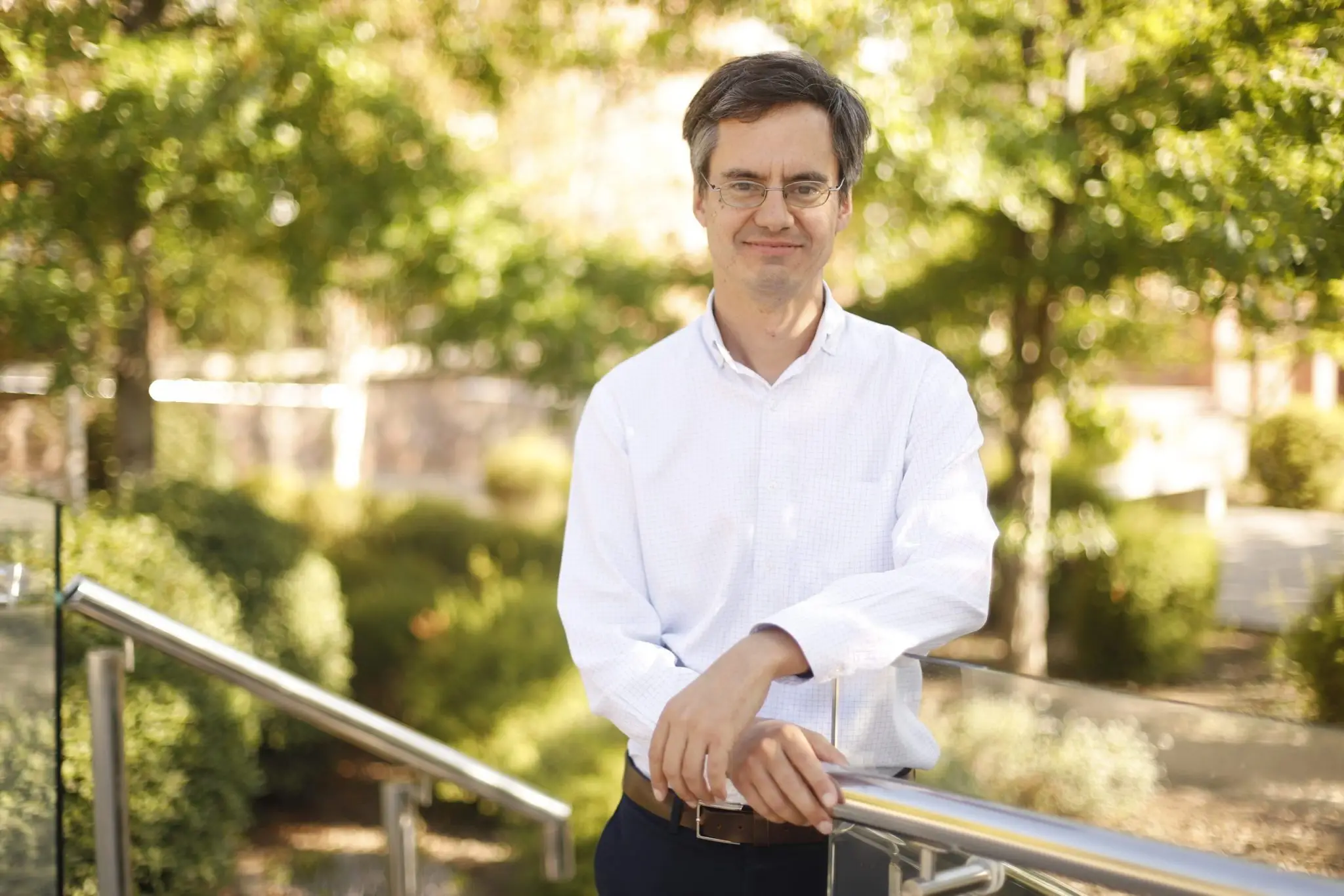
José Delpiano, an academic from the School of Engineering and Applied Sciences, uses AI, through Arbocensus, to investigate how to prevent the failure of tree branches, based on information provided by neighbors and images taken with cell phones, and thus avoid possible damage.
José Delpiano, a researcher and faculty member at the School of Engineering and Applied Scienceswas recently awarded a Fondecyt Regular 2025 with his project, "Computer vision-based characterization of urban trees with considerations for risk assessment." This consists of the development of Arbocensus, a platform to record images and data on trees, with the aim of preventing damage that may be caused by their falling or the detachment of their branches.
“We have already accumulated images and information on about 14 thousand trees, and what is being done is the evaluation of the risk associated with each one, because every time there is bad weather we have to deal with the fall of branches or entire trees, with damage to infrastructure, cars, and even injuries or death of people. The idea of this project is to study a key component of this risk, the probability of failure of branches or a tree, based on information provided by neighbors and images taken with cell phones," explains the researcher.
Delpiano comments that this project has a great impact on society, especially taking into account that professionals trained in urban tree risk assessment are scarce. "The budget of municipalities for these preventive assessments is limited. The AI models we obtain will be useful to rule out trees that do not present a risk and focus the time of professional evaluators on other trees or areas of the city," he explains.
The co-investigators of this research are Matías Recabarren, an academic of the School of Engineering and Applied Sciences and expert in human-computer interaction, who has been in charge of the development of the software platform; José Antonio Abell, professor of the School and expert in soil-structure interaction, who will study the possibility of modeling the mechanical resistance of a tree from images; and Tito Arévalo, professor at Pontificia Universidad Católica, expert in remote sensing, who will provide information on more complex sensors such as infrared cameras and LIDAR.