
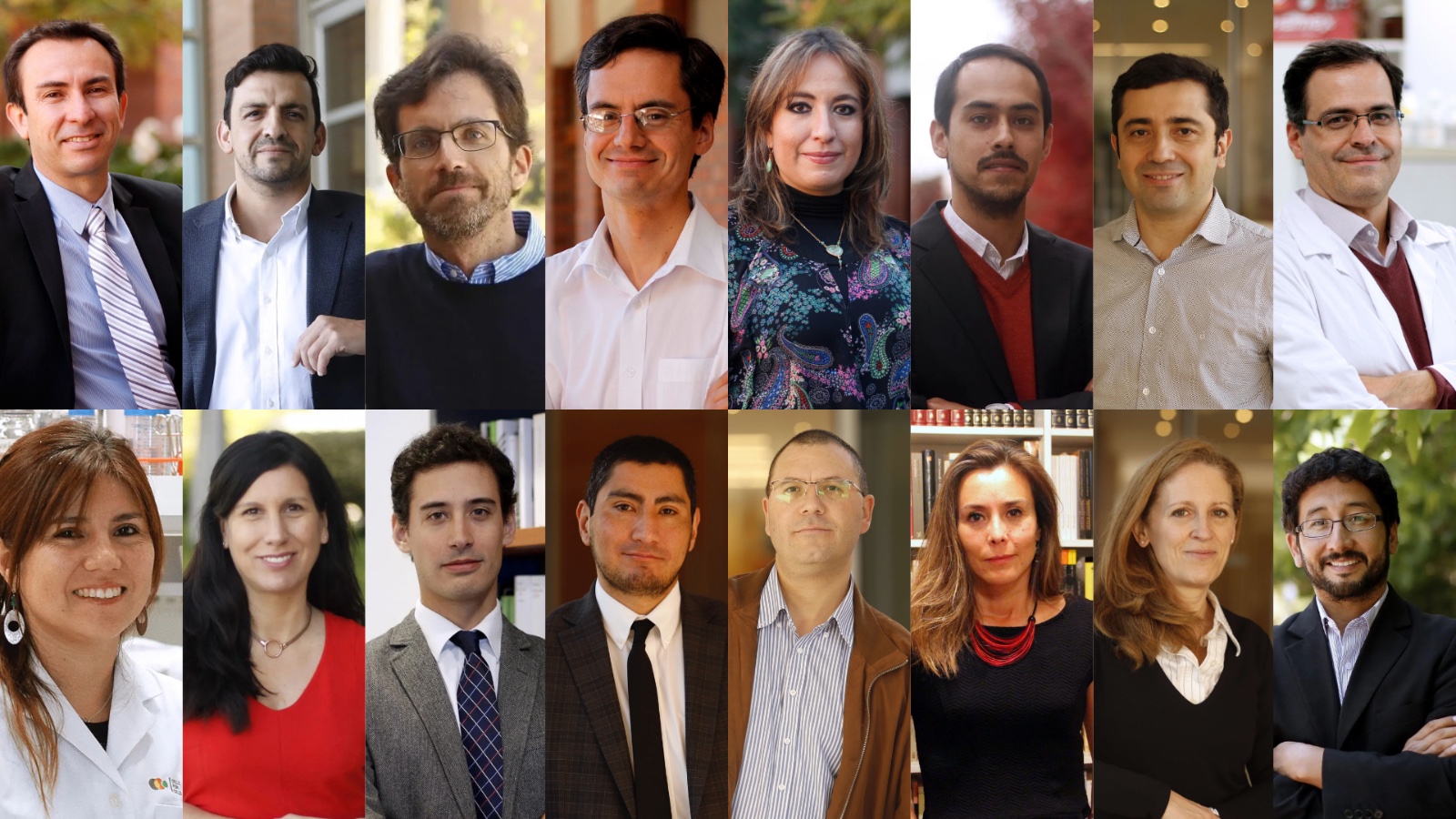
The research seeks to generate concrete solutions to current challenges in different fields of knowledge.
Universidad de los Andes was awarded 16 projects in the Fondecyt Regular 2025competition. The research will cover a broad spectrum of disciplines ranging from the applied sciences to the humanities, demonstrating the multidisciplinary nature of its research. Research will be conducted on neurodevelopmental disorders; new therapies for rheumatoid arthritis; biocomposites with potential medical applications; ultra-high performance concrete; chaotic phenomena in magnetic systems; development of computer vision systems for the evaluation of urban trees; port optimization and advanced machine learning models; and the use of mobile devices in rural classrooms, among others.
These projects reflect our commitment to research excellence and the generation of knowledge in multiple disciplines.
Claudia Brizuela
The academics leading these projects are: from the School of Engineering and Applied Sciences , Patricio Moreno Casas, Patricio Valenzuela Aros, Jaime Cisternas Elgueta, José Francisco Delpiano, Rosa González Ramírez, Felipe Scott Contador and Miguel Carrasco Briones; from the School of Medicine, Professors Luis Federico Batiz and Patricia Luz Crawford; from the School of Social Sciences, Professor Isabel Pavez Andonaegui; from the School of Law, Rodrigo Guerra Espinosa and Sebastián Contreras Aguirre; and from the School of Philosophy and Humanities, Professors José Miguel de Toro, Macarena Cordero Fernández, and Gabriela Rossi.
In the area of engineering and technology, research will focus on ultra-high performance concrete, chaotic phenomena in magnetic systems, and the development of computer vision systems for the evaluation of urban trees. Port optimization and advanced machine learning models will also be addressed. In the field of biomedical sciences, researchers will delve into neurodevelopmental disorders and new therapies for rheumatoid arthritis, in addition to studying innovative biocomposites with potential medical applications. The social sciences will be represented by research on the use of mobile devices in rural classrooms, seeking to understand and improve education in vulnerable communities. In the field of law, studies on the principle of harm in specific cases and an analysis of Grotius' work will be developed, contributing to the development of legal thought. In the humanities, research will explore medieval encyclopedic literature, the inquisitorial government in the district of Lima, and the convergences between the ethics of Aristotle and Kant.
Learn more about the researchers and their research here
"These projects reflect our commitment to research excellence and the generation of knowledge in multiple disciplines," said Claudia Brizuela, director of Research and PhD, who added that "the variety of topics addressed demonstrates our university's ability to contribute to the country's development from different perspectives."
This year's award rate was 31%, which is in line with the national historical average for these competitive funds.
Complete list of awarded projects:
| Project Title | Academic Unit | Principal Investigator |
| Assessing Fiber Orientation and Distribution in Ultra-High-Performance Concrete (UHPC) Through Advanced Computational Modeling and Experimental Analysis | School of Engineering and Applied Sciences | Patricio Moreno Casas |
| Distance, innovation, and inclusive growth during crises: Evidence from small businesses | School of Engineering and Applied Sciences | Patricio Valenzuela Aros |
| Chaotic phenomena in magnetic systems: theory, experiments, and data-driven modeling | School of Engineering and Applied Sciences | Jaime Cisternas Elgueta |
| Computer vision-based characterization of urban trees with considerations for risk assessment | School of Engineering and Applied Sciences | José Francisco Delpiano |
| Improving port performance by enhancing berth planning at multipurpose port terminals | School of Engineering and Applied Sciences | Rosa Gonzalez Ramirez |
| Increasing isopropanol and (R)-1,3-butanediol yields and titers from H2, CO2, and O2 via pathways orthogonalization and the coupling of enzyme/pathways properties to cell growth as a selection proxy. | School of Engineering and Applied Sciences | Felipe Scott Contador |
| Robust Models for Feature Selection in Machine Learning | School of Engineering and Applied Sciences | Miguel Carrasco Briones |
| Disruption of mTOR/FOXO3 balance in interneuron progenitors as a pathogenic mechanism linking prenatal stress and neurodevelopmental disorders | School of Medicine | Luis Federico Batiz |
| Unraveling the role of Mitophagy Triggered by Exogenous MSC-Derived Mitochondria on memory T-CD4 cells as a Novel Therapeutic Mechanism for Rheumatoid Arthritis. | School of Medicine | Patricia Luz Crawford |
| Use of mobile devices in the rural classroom: Exploration in vulnerable educational communities from the perspective of the teacher's digital ecosystem. | School of Social Sciences | Isabel Pavez Andonaegui |
| In defense of a reinterpretation of the tort principle in cases of injury, infanticide and mercy killing | School of Law | Rodrigo Guerra Espinosa |
| The Middle Way of Grotius | School of Law | Sebastián Contreras Aguirre |
| The Orient in the encyclopedic literature of the Iberian Peninsula during the 14th century. | School of Philosophy and Humanities | José Miguel de Toro |
| The inquisitorial government of the police stations in the district of Lima. Territorialization of power, justice and social-political control. | School of Philosophy and Humanities | Macarena Cordero Fernández |
| Explorations of possible convergences between Aristotle's and Kant's ethics. | School of Philosophy and Humanities | Gabriela Rossi |
| A novel approach based on the use sulphated cellulose nanofibrils to modify the self-association and self-assembly of amylose-amylopectin as a strategy for the tailored design of multifunctional biocomposites | School of Medicine | Paulo Diaz Calderon |